Wednesday, February 5, 2020

THE NUMBERS DON'T LIE


In the world of high stakes athletics nothing seems more important than statistics.
The numbers an athlete posts can provide a quantifiable answer to the pertinent question,
“What have you done for me lately?


It may seem cruel and a bit callous, but spots on teams are often earned and lost primarily based on the stats an athlete produces. Countless hours on sports talk radio and cable tv are dedicated to endlessly rehashing the statistics athletes put up. The obsession with the sports stars and the numbers they produce can be mind boggling to the point that I rarely, if ever, even follow those radio and tv shows anymore. There’s just too much over-analyzing and rampant speculation to hold my interest.
What is the point?

A mock draft?
Who cares?

Trade speculation?
Why not wait until an actual trade is made?

Second guessing the manager of your favorite baseball team?
Sure, that’s pretty easy Jethro, from the comfort of your Barcalounger, armed with very little of the experience and information the manager had at hand.

I guess maybe I just believe that different numbers should be looked at to make more valid analysis of athletes.

I’m not referring to the new analytics that are taking over baseball with sabermetrics, and PECOTA, as described in the book, MONEYBALL, by Michael Lewis, and depicted in the movie of the same name, starring Brad Pitt.

Many proponents swear by those methods.
I prefer looking at the figures in a different way of my own.
Perhaps mine might be a better way of taking the measure of the man.

As a kid growing up in Minnesota in the 60’s and 70’s I skated on our backyard rink and rooted for Gopher hockey, the NHL’s North Stars, and the Fighting Saints in the WHA.
The guys who played on those teams were my heroes, and what I aspired to become.


Unfortunately I never made it there.
Far from it.
But some of those guys still remain heroes to me.


One of those heroes is a fellow named Ted Hampson.
Late in his career Hampson played two seasons for the North Stars and then 4 with the Fighting Saints. As a fan I really liked Ted because, like me he is a smaller guy, standing 5 foot 8 inches tall (just a little bit taller than me).

Ted could score goals, provide assists, and do whatever the team needed.
In 1969, as a North Star, he won the Masterton Trophy, which is awarded to the National Hockey League player who best exemplifies the qualities of perseverance, sportsmanship, and dedication to hockey. In 1973, while playing for the Fighting Saints, he won the Paul Deneau Trophy as the WHA’s most gentlemanly player.


Winning those awards was quite an accomplishment for Ted. More impressive though may be the fact that at the end of Ted’s career the United States Hockey League (a midwestern junior hockey league) named their award for perseverance and sportsmanship the Ted Hampson Award.
A good friend of mine named Tom won that award the year he played juniors.

If memory serves me correctly the award came with a plaque and a small scholarship check since junior hockey players primarily play to catch the attention of college hockey scouts and coaches in hopes of earning scholarships and a spot on a college hockey roster. Tom earned a college scholarship, had a successful college hockey career, graduated, and went into coaching for many years, at a lot of different levels and locations.

A big part of coaching in juniors and college is scouting and recruiting players.
At any high school game there is invariable a cadre of scouts and coaches in the upper rows of the stands evaluating the talents and potential of the kids giving it their all on the ice down below. The coaches could rely solely on the players’ statistics to evaluate talent, but there’s really no substitute for watching an athlete do their thing in person.

Spending so much time in rinks evaluating the same pools of kids means that many of these scouts and coaches get to know each other fairly well. Conversations are struck up, old tales are retold, and friendships are formed.

A couple of years ago, attending a high school hockey game with Tom, my friend who had won the Ted Hampson Award, we ran into the actual Ted Hampson, who now scouts for the Vancouver Canucks. Tom and Ted had become friends over years of scouting in a myriad of rinks across North America.

There is a school of thought that says you shouldn’t meet your heroes.
You’ll only be disappointed.
I've never believed that.

I was honored to meet Ted. He was a pretty nice guy but we only had the opportunity to chat for a short while. You see Hampson was at the game with his wife and he was going to get something to eat and needed to get back to his seat beside her before the next period began.

We saw Ted’s son Gordie sitting in the stands with his mom, so Tom pointed out Gail Hampson, Ted’s wife, to me. He then explained to me that Gail suffered from dementia so Ted pretty much cares for her full time except when he has a game to attend. Occasionally Ted could bring her along, but increasingly more often he now needs to arrange to have a nurse come care for her while he is busy evaluating hockey players.

Tom also told me that early on in his friendship with Ted Hampson, decades after Tom won the Ted Hampson Award, he told Ted about how honored he had been to win the award, and that the fact that Hampson’s name, one of the hockey players Tom admired the most, was attached to it, made it so much more meaningful.

Tom Hanks, as manager Jimmy Dugan, in the movie A LEAGUE OF THEIR OWN, famously said,

“THERE’S NO CRYING IN BASEBALL!”


Well there’s none in hockey either, except on occasion the combination of Zamboni fumes and fluorescent lighting can cloud up your contact lenses and make the eyes of some in the stands to water a bit.
I’m told that that night, when Tom shared that story with Ted, it was one of those eye-watering occasions.
Even though neither of them wear contact lenses.
That’s their story though, and they’re stickin’ to it.


Sadly, on January 14th of this year, Ted’s wife, Gail Hampson passed away.

I heard about it a few days later through social media.
The next Saturday Tom and I went to watch a high school game.
I asked if he had heard that Mrs. Hampson had passed.
He hadn’t, but he knew that another friend, Frank, who scouts with Ted, and meets him for coffee every Wednesday, would probably have first-hand information.

After that period we sought Frank out.
He filled us in on the details and shared a touching story with us.

Gail died peacefully on a Tuesday.
The final arrangements were made and the funeral was planned for a Monday two weeks later.
Ted had done all he could do for Gail, for the time being, so when Frank offered to take Ted to watch a high school game the Saturday after Gail passed, Ted agreed to go.

As Frank told the story he was glad to get Ted back in an arena and doing something he really enjoyed. After a time though Ted developed a bit of a preoccupied expression, a thousand mile stare. Finally Ted told Frank that he had been wracking his brain, he had a nagging feeling he had forgotten to do something. It finally occurred to Ted, he had forgotten to arrange a nurse to stay with Gail.

But then he remembered that Gail was gone.
There’d be no more nurses for Ted to arrange.
After 61 years of marriage Gail is now gone.

61 years of marriage.
61 years as a devoted husband.

In my view THAT is the most important stat, and the greatest accomplishment, that Ted has yet achieved.

It’s also why he remains one of my heroes and I’m glad I was fortunate enough to meet him. .

The numbers don’t lie.


Sunday, January 5, 2020

SOMEONE SAVED MY LIFE TONIGHT


I’ve never claimed to be a very good husband.

I was just extremely fortunate to win the hand of a very special bride.

She’s put up with my nonsense and hi-jinx for more than 4 decades.
She is such a forgiving soul.

One of the more prominent recent examples of her special grace is the fact that she didn’t
divorce me despite the fact that I left her alone, in our marital bed, on our 38th wedding
anniversary this past August while I spent the night in another bed in the company of 6 other
women I had just met that night.

Let me explain.

My Lovely Bride and I both planned to leave work early on August 29th in order to get home to
fire up the grill and prepare a nice meal together of steak, grilled asparagus, a pear gorgonzola
salad, and some Ben and Jerry’s Oat of this Swirled ice cream for dessert, followed up by a walk
and perhaps a movie.


Being as that day was near month-end, as an accountant, I was unable to leave work as early
as I wanted.
Since my bride is a library manager she was held up at work and arrived home even later than I
did.

But fortunately not too much later.

As I waited at home I felt the weird sensation of the left side of my tongue swelling.
I looked in a mirror and noticed a strange puffiness that I now know is referred to as geographic
tongue. Half of my tongue looked like the puffy roof of the Metrodome stadium from the outside.

My wife called to say she was on the way home and as we spoke she wondered why my voice
sounded so strange. (It wasn’t entirely unusual for me to go an entire weekend punctuating
EVERY one of my responses to her with “AMUNDO!” a la The Fonz, Arthur Fonzarelli
from the tv show “Happy Days” because, well, why not? Somehow she tolerated that and didn’t have her attorneys contact mine.)

I explained to her that my tongue felt thick and that I was getting quite itchy.

Fortunately she was only a few minutes from home.

When she pulled up in front of our house she told me to jump in so we could get to a doctor.
I would have just shrugged the swelling off.

Luckily we don’t live very far from Methodist Hospital so we headed there.

A word to the wise; if you’ve ever complained about long wait times at an Emergency Room you
may want to try telling the triage staff that you have a blocked airway.
I have NEVER been admitted so rapidly. ANYWHERE!

The attention was somewhat gratifying until about a dozen healthcare professionals descended
on me and I heard talk of prepping one of the BIG ROOMS for me, “just in case.”
In case of WHAT?

I probably didn’t want to know.

My wife DEFINITELY didn’t want to know.

Thankfully, though we used one, the bigger room was not really needed.
We did find out that what had happened was an anaphylactic reaction.

To what?

We don’t know that yet.

I spent that night in the hospital, got tested for allergies, and now carry Benadryl and EpiPens.
Just in case.

The six women I referred to earlier were a doctor, nurses, lab techs, and respiratory therapists, that cared for me that night.

In sharing this episode over the last few months I’ve heard from multiple people that they are
supposed to carry EpiPens too, but many don’t because of the expense.
I’ve encouraged them to rethink that as it could potentially mean the difference between life and
death.

LIFE AND DEATH.


On Saturday November 7th, 1987, the Michigan Wolverines came to Minneapolis to play the
Golden Gophers in football.
During that game, Darrell Thompson, a man I didn’t know at the time, but would come to know
well when I went back to the U, in 1988, to work in the football equipment room, took a
handoff in his own end zone and ran 98 yards for a Gopher touchdown, (still a UofM record)
It was later found out that at some point during that game legendary Michigan Head Coach, Bo
Schembechler, suffered a mild heart attack.


Bo maintains it happened during that Thompson touchdown run.
When asked about the cardiac event, at a later date, Schembechler boasted,
“It probably woulda killed a lesser man.”

I ALWAYS loved that quote, however, on New Years Eve, Tuesday December 31st, 2019, I
damn near became THAT lesser man.

Let me explain.


After a gathering with old high school friends in the afternoon, and a really nice dinner at home
with family, I was looking forward to an early evening New Years celebration at a time suitable to
our (soon to be) 6 and 2-1/2 year old grand daughters.


But then my tongue started feeling funny,
And soon after that I felt the need to go to the bathroom, and rapidly thereafter nausea set in.
I grabbed my Benadryl, and EpiPens, yelled for my wife, and headed to one of our bathrooms.

By the time she arrived, seconds later, my wife found me with my EpiPens.
In my telling it I was too shaky and weak to use the pen.

What she saw was me holding the pen to my thigh and staring at it like one of those drug addled
addicts portrayed in bad late 60’s TV cop shows.

This ALL progressed at an alarming rate of speed.
I only remember bits and pieces of the rest of the evening.

Lost to me was;
My wife giving me the first life-saving EpiPen injection.
The paramedic giving me the second.
My daughter dialing 911.
My daughter-in-law hustling the grandkids to another part of the house to shield them from what
was about to happen.
Hopkins police in my living room.
Hennepin county sheriffs deputies in the house.
Paramedics in my bathroom with me.
The large man who single-handedly picked me up and placed me in a stair chair after I blacked
out the second time.

I was out cold for ALL of that.

Gone-zo.

NOT.
A.
CLUE.

2020 damn near became a foreign shore I never reached.

If not for the fast-action of my wife, family, and the first responders, I wouldn’t be telling you this
story right now.
Instead, you’d most likely be trying to think of what to say to my family at my funeral.

My wife saved my life that night.
My wife, and EpiPens.


German author Johann Wolfgang von Goethe said, “Every second is of infinite value.”

They sure were this past New Year’s Eve.
And they sure will be, to me, from here on out.

I feel like I’ve been granted bonus time.
Time to do the important things.

One of the important things is to tell this story, in order to encourage people to get their
EpiPens.
Please allow someone to save your life as well!


POSTSCRIPT
A direct result of blacking out can be a dramatic drop in blood pressure which can shock the
colon leading to Ischemic Colitis and additional hospitalization.
Yep, I got that too.
I hope to post this story on 1/5/20, which, cross your fingers, may be the first day of 2020 that I
WON’T be in the hospital.
It can’t go anywhere but up from here!

Friday, September 13, 2019

THE SPENDING OF IT'S NEVER DONE


It’s interesting how the passing of time and the accumulation of years can change a guy.
These days I seem to move a little slower and pay a lot more attention to what happens around me.

I seem to make more connections between past, present, and future.

I don’t know whether it is the end of summer and the approaching fall season, or the fact that I’m entering the autumn of my years, but thoughts of ancestors and legacies are foremost in my mind.

I’ve noticed that the people across the street, a young couple with an infant son, have been doing a lot of work on their house this year.
Landscaping,
Exterior painting,
New gutters installed.
Most of the work is actually being overseen, and largely performed, by the husband’s dad.

Reminds me of our place.
My dad “helped” us in the same way with a lot of the projects on our house.
Installing doors,
Wiring circuits,
Pouring a concrete patio.


When considering his legacy after he passed away in January of 2012 we kept circling back to the building that dad did over the years.
Pre-fab houses while in college,
The lake home in Ely,
And church congregations throughout his career.

Building tangible things that will survive beyond your days.
What a great legacy for dad to leave.


I was considering that, on Labor Day, as I sat on our front porch deck that dad and Junior built together years ago. Looking across the street I watched as the neighbors jack-hammered the cement stoop off of their house, and began framing in a front porch deck of their own.

Knowing the enormity of such a project I waited until early evening, when the work was being completed for the day, and tools were getting packed up, to wander over to check on their progress.

I introduced myself to the grandfather/foreman of the project.
I asked a few questions about how the project was taking shape when the older man said,
“We’re trying to build it similar to the one over there.” as he pointed at our house.

I laughed and said, “That’s my place. My dad and son built that deck a few years back.”

“Well,” he said, “My hat’s off to them. All my son kept saying was, ‘My neighbor has a deck out front and he sits out there all the time! I‘d like one of those too.’”
The man continued, “How could I say no to that?”

As a dad and grandfather myself I know he couldn’t say no.

It wasn’t until I arrived back on my deck that it struck me.
Not only did we have physical evidence of dad’s impact on the world, I now had proof that, more than 7 years after he was gone, he was still inspiring others with his works and the example he set.

While pondering that I came across this passage from Ernest Hemingway’s FOR WHOM THE BELL TOLLS,

“I had an inheritance from my father,
It was the moon and the sun.
And though I roam all over the world,
The spending of it’s never done.”

Yep dad, your legacy is constant, like night following day.
It’s universal, I see it in so many of the places I go.
And, I’m beginning to believe it’s everlasting, that it’ll carry on long after I am gone.

I guess that’s how things pass; from father to son.
And the spending of it is never done.


Sunday, August 18, 2019

THE CUT OF HIS JIB


I married into a Navy family.

My father-in-law and two brothers-in-law all served in that branch of the military.
Two of them served as radio men, one in Texas, and the other on an aircraft carrier all over the
globe. The third was a yeoman purser, performing clerical duties on a submarine.

While their duties seem less Navy specific than other roles in the military, in talking to them I did
find out that they each received some general seamanship lessons during Basic Training.


Having myself descended from woodland Native American and rural German American stock,
and NOT having served in the US Navy, I am a confirmed novice regarding all things maritime.
I know absolutely nothing about hoisting a mainsail, battening down hatches, nor why the part of
a ship named the “Forecastle” is pronounced as “folk-sill”.

I guess we can agree that, when off of dry land, I don’t even know my fore from my aft!

I’m okay with that though. The sailing term I’m most familiar with is the oft used (at least back in
the day) comment,

“I like the cut of his jib!”

The jib is the smaller sail, without a boom, that hangs off the mast ahead of the much larger
mainsail. Some sailors believe that the jib is the face of a sailing vessel.


The URBAN DICTIONARY defines the term, ‘The cut of your jib’, as,
“An old sailor’s term for one’s intangible qualities. Often judged on first impressions.”

Conventional wisdom states that we shouldn’t be too quick to judge; shouldn’t judge a book by
it’s cover.

But we all do it.
I know I have.

Sometimes that first impression is all you really get to make a determination.
It’s always gratifying when your first impression of a person is borne out over time.

Here’s one that worked out for me.

Over my travels I’ve met an awful lot of interesting people with a vast array of stories to tell.
I was fortunate enough to have a lot of good friends from high school including a kid named
Danny O’Hara. Danny was a ballboy for the Minnesota Twins.
I haven’t heard a lot of his stories, but I bet he’s got a ton of them.


Dan was the kid, in uniform, on the field, stationed down the first baseline, on a chair, on the
warning track that butted up against the stands at the old Metropolitan Stadium.
His on-field duties during the game included shagging foul balls, and playing catch with the
right-fielder between innings to warm-up.

Growing up in Bloomington we used to go to a lot of Twins games. The team didn’t draw a lot of
fans some years so we merely had to buy cheap tickets to get in the door and then we could sit
pretty much wherever we wanted to.

On a summer Sunday afternoon in (I believe it was) 1978 we decided to sit along the rail so in
addition to his regular duties Dan also got to entertain me, another friend I was at the game with
and the young first base umpire Steve Palermo, who, seeing us chatting it up came over to visit
between innings.


Palermo seemed like a really nice guy. I felt kind of bad for initially telling him my name was Al.
You see the American League umpires all wore hats with an “AL” on them for American League.
Back then an AL hat would’ve been about impossible to get. Nowadays you can get just about
anything online. I figured I’d appeal to his sense of justice; who better to have an AL hat than a
guy named Al. I thought it’d be cool to wear one since everybody else was wearing their favorite
team’s hats that I’d be the outlier wearing an umpire’s hat.

It didn’t work though. I didn’t get the hat. But I was gaining a new friend.
(I confessed my lie to Palermo and he got a laugh out of that too!)

I liked the cut of Palermo’s jib.

After the next half inning he came back out to where we were sitting and told a few jokes.
All these years later I still remember one of them.

“What’s the difference between a hippo and a Zippo?
One is REALLY heavy and the other is a little lighter.”
Ba-dum-tss!

Who can’t like a guy that’d start telling bad jokes to folks he just met?
Ya gotta like the cut of that jib.


Nine years later, on August 3rd, 1987, Steve Palermo was on the umpiring crew, in Anaheim
California, that found an emery board and sandpaper in the pockets of Twins knuckleball pitcher
Joe Niekro. American League President Bobby Brown suspended Niekro for 10 days.
A few nights later David Letterman had Niekro on his show wearing a tool belt with a power
sander attached to it.

I could have been mad at the umpires that busted the Twins pitcher but Palermo joked to
Minneapolis Star Tribune baseball writer, Jerry Zgoda, that perhaps Niekro, or the umpiring
crew from that night (Palermo, Chief Dave Phillips, Tim Tschida, and Dan Morrison) ought to be
in line for endorsement deals from either Black and Decker or Revlon.

On the field Palermo was all business, but he could joke about things after the fact.
He seemed like a really good guy that way. What’s not to like about that?

Fast forward to July 7th, 1991. Palermo was out to dinner at Campisi’s, an Italian eatery in
Dallas Texas, after having worked an Angels/Rangers game. Someone rushed into the
restaurant and yelled that two waitresses that had just left the building were being assaulted out
in the parking lot.
Palermo and five other good guys rushed outside to offer assistance.

Shots were fired.

Palermo was hit.

The bullet severed the nerves at the base of Palermo’s spine.
Six weeks later he began regaining the use of his legs.

Using crutches, and with some assistance, Palermo threw out the first pitch at the World Series that year.
After years of daily physical therapy he was able to walk with a cane.


Palermo never worked as an umpire again after that fateful night.
Major League Baseball did hire him on as an assistant to work on special projects.

Steve Palermo died from lung cancer on May 14th, 2017. He was 67 years old.

In his later years, whenever he was asked whether he ever regretted running out into the
parking lot of that Dallas restaurant, Palermo gave the same answer,

“It’s NEVER a mistake to help someone in trouble.”

I just loved the cut of Steve Palermo’s jib.

Friday, July 19, 2019

THEY CAN PUT A MAN ON THE MOON, BUT...


I try to be observant as I travel about my daily business.
Sometimes I see some interesting stuff, sometimes not.

I’m pretty confident that when I was younger I wasn’t as aware of things occurring around me.

My Lovely Bride certainly will attest to numerous profound items that have escaped my notice over the years.
Important dates.
Family members’ new hairstyles.
Entire rooms of furniture being rearranged.

Historically I just haven’t been very aware of stuff around me.

Lately I’ve been racking my brain trying to recall how the wags and social commentators used to complain, prior to July 20th, 1969, when US astronaut Neil Armstrong uttered,
“That’s one small step for man, one giant leap for mankind.”
I can’t recall.
I just know that ever since then people have prefaced complaints with,
“They can put a man on the moon, but they can’t…”


I do recall back in the day that people used to say that things were, “the greatest thing since sliced bread”. I’m old, but not old enough to recall a time when bread didn’t come sliced.
Perhaps years ago the complaint may have been made that,
“They can mass-produce uniformly sliced bread but they can’t…”
Maybe, but most likely not.

At times I wonder whether anyone at NASA, having heard so many complaints qualified with their incredible lunar achievement over the years, ever felt frustrated that their efforts seem to be trivialized. 

I hope not.


In spurring the US efforts in the space race, President John F. Kennedy, on May 25th, 1961, asked congress for additional funds for NASA saying that,
“...this nation should commit itself to achieving the goal, before the decade is out, of landing a man on the moon and returning him safely to the earth.”


On September 12th, 1962, in a speech at Rice University JFK added,
“We choose to go to the moon. We choose to go to the moon in this decade and do the other things, not because they are easy, but because they are hard; because that goal will serve to organize and measure the best of our energies and skills, because that challenge is one that we are willing to accept, one we are unwilling to postpone, and one we intend to win, and the others, too.”


Almost 50 years to the day after astronauts Armstrong and Buzz Aldrin landed on the moon with an audience of millions, including one short, fat kid, in Bloomington Minnesota, that very kid, now a grampa, has a challenge to issue to the powers that be, or, the “THEY” that sent a man to the moon.

Technology developed by NASA for the space missions has brought us many items that we use each and every day.

Eyeglass lenses used to be actual glass back in the day.
Those were dangerous however since they could shatter into shards that might injure the wearer.
In 1972 the US Food and Drug Administration mandated that the lenses for all glasses and sunglasses needed to be shatter-resistance.

That meant plastic, but plastic is prone to scratching.

NASA scientist Tom Wydeven, working out of the Ames Research Center, developed the thin, scratch-resistant coating for space helmet visors that now protects most of the eyeglasses sold in the United States today.

Space capsules have limited stores of water that can be transported to and from outer space.
NASA engineers, in conjunction with an Oregon company, Umpqua Research, developed cartridges that use iodine to clean water during the space missions. This technology has, since the 1970’s, become an increasingly popular method employed by municipalities to purify the tap water we all drink on a daily basis.


I just recently heard of medical technology that NASA developed at the Goddard Space Flight Center that has made a friend’s life easier. Her husband is diabetic. In the past he had to prick his finger twice a day to check his blood sugar level and to adjust his diet and meds accordingly.

My friend went about her day with the fear, even though the possibility was remote, that her husband could have had a diabetic reaction, lost consciousness, and been unable to correct the situation.
His newly implanted, NASA developed, insulin pump monitors his vital signs and blood sugar levels and automatically releases insulin as needed.

Further, the pump notifies him, via his cell phone, in case his blood levels spike in either direction, his vitals show irregularities, or if the pump malfunctions.
The added bonus is that the notifications are sent to his wife as well.
My friend relates that the peace of mind that technology provides is priceless to her.

Back in the day mood rings became a popular item.
They contained quartz stones bonded with liquid crystals, set in rings that purported to identify the mood of its wearer with changes in color. In reality variations in temperature were the only thing reflected with a mood ring. They became the precursor for those thermometers parents can use by placing them on their child’s forehead.


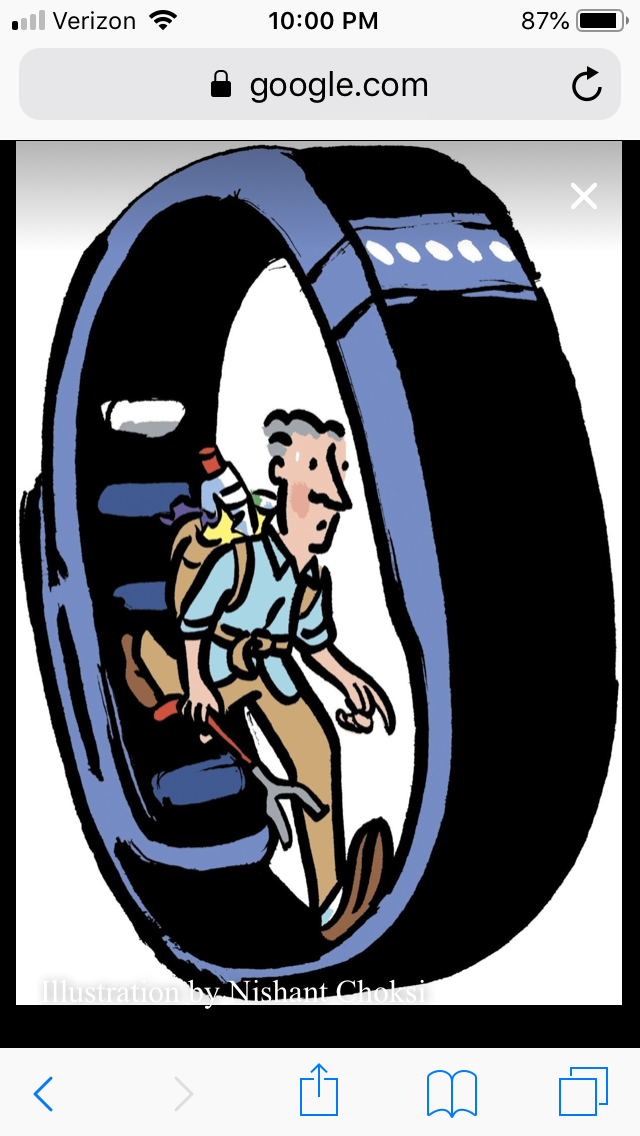
A lot of us now where an awful lot of technology on our wrists these days. Fitbits, Apple watches, and Garmins provide us a lot of information, entertainment, and even encouragement.
Noted author David Sedaris tells the tale of how the Fitbit he purchased with a goal of 10,000 steps a day, combined with his obsessive personality, now has him regularly logging 60,000 steps a day. If 10,000 is good, isn’t 20,000 better? And 30,000 even better yet? Etc. etc.

My challenge to the scientists at NASA?

They can put a man on the moon, but 50 years later they can’t come up with a Fitbit for mental health? Sure I’m issuing a tough challenge, but didn’t JFK say that we do the hard things?

The National Alliance on Mental Illness (NAMI) estimates that;
●     1 in 5 (46.6 million) adults in the US experience a mental health condition in a given year.
●     1 in 25 (11.2 million) adults in the US experience a serious mental illness in a given year.
●     Up to 90% of those who die by suicide have an underlying mental illness as revealed by psychological autopsy. 46% of those who die by suicide have a diagnosed mental illness.
●     Suicide is the 10th leading cause of death in the US. With effective care, suicidal thoughts are treatable, and suicide is preventable.

Mental illness has long held a stigma in our society so it rarely is openly discussed.
Oftentimes people struggle in silence despite the fact that help is available.

The science is wa-a-ay above my head, but I’d like to see work dedicated to developing a device, be it a ring, a watch, a cell phone app, or even an implantable device, that would deliver the promised feedback of a mood ring, the social acceptance of a Fitbit, and the diagnostic ability and communication function of an insulin pump.

Who among us wouldn’t welcome a tweet or text informing us that a friend or family is lonely or hurting?
All too often we don’t find out until it is too late.
I’d like to find out earlier so I could offer help.

They say that the Information Age (where info was the point) is ending. We are now entering the Experience Age, whereby pictures and mobile technology make the stories we tell more vivid.
We are entering a “Show, don’t tell” era.
techcrunch.com/2016/05/09/the-information-age-is-over-welcome-to-the-experience-age/

Information is still important. It always will be. Sharing the MOST IMPORTANT INFORMATION with others who care, and will help, is where we are lacking.

If we can put a man on the moon why can’t we make things more bearable for ALL mankind on earth?